International and Cultural Studies
The International and Cultural Studies major will educate students about emerging global and international issues concerning culture, politics, art, religion, and social policy. The purpose of the major is to produce an informed and broadly educated global citizenry who can then take this learning to both private and public sector professions and arenas that address a wide variety of international issues and global challenges. International and Cultural Studies students will take a set of core courses in religion, politics, geography, literature, and history. They will then develop a track of courses in a particular thematic area -- for example: Western civilization, non-Western civilization, international relations, religious studies, global arts and architecture, global issues such as global health; comparative studies, European studies, European studies, British studies, Asian studies -- that corresponds to their intellectual interests and professional goals. This knowledge will require language skills, living-abroad experiences, analytical and reasoning skills, cross-cultural attitudinal skills, substantive knowledge about geographic areas, and knowledge about specific contemporary global and cultural issues and processes.
Because the major is 36 credits, excluding foreign language requirements, students will be able to double major or minor in an area that complements their International and Cultural Studies major.
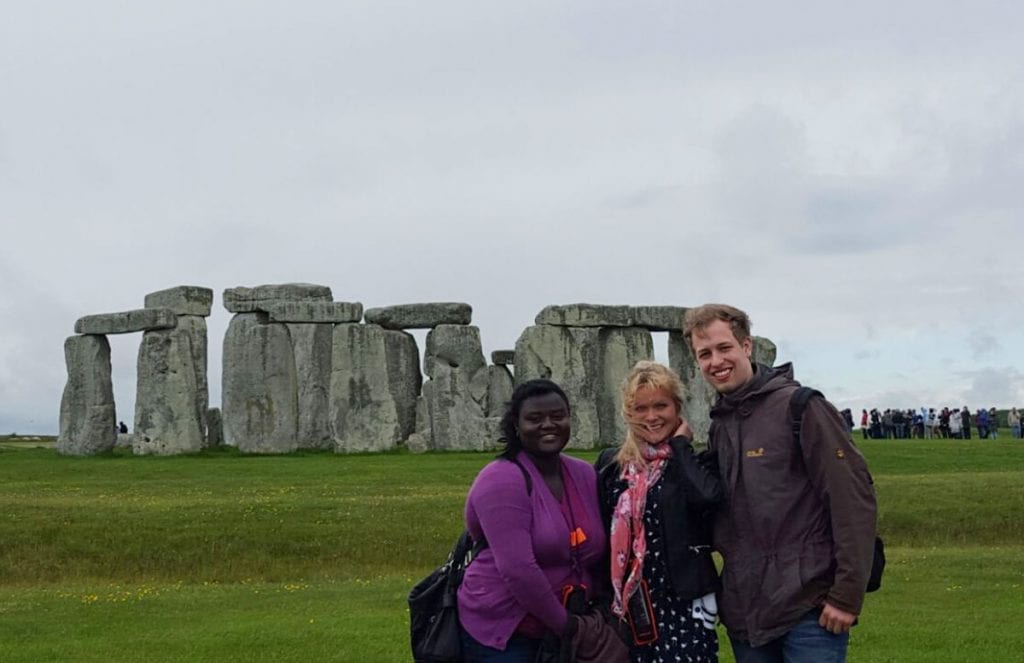
Study Abroad
As a student of liberal studies, you may take full advantage of our consortium agreement with other schools. You could spend a semester abroad or partake in the other exchange and internship opportunities available for liberal studies majors. For more information, explore our Study Abroad opportunities.
Highlights of the Major
- Minimum of 36 credits (excluding language)
- Required introductory course on intercultural studies (3 credits)
- Required core of 5 courses in government, history, geography, religion, and world literature (15 credits)
- Focus on a track (area of concentration) through within-track courses (minimum of 5 elective courses or 15 credits)
- Required capstone course (3 credits)
- Foreign language (Intermediate II level with C- or better, or proficiency exam)
- Study-abroad experience (minimum of 3 credits - part of the Electives category)
- Option of specialization within major via designed or individually designed tracks
- Minor of 15 -21 credits is required
- ENGL 101 - COMPOSITION: THEME WRITING
- ENGL 104 - COMPOSITION: THE ESSAY
- MATH 115 - CONTEMP MATHEMATICS
- or above
Please Note: General education requirements may be revised slightly at the discretion
and approval of both the adviser in the area of concentration and the program director.
One Course in each of the following areas:
- Fine Arts: art, music, performance, aesthetics 3
- Literature or foreign language 3
- Philosophy 3
- Two courses in humanities or fine arts 6
- Two courses in American history or government 6
- Social Science elective from one of the following:
ECON, HIST, PSCI, SOC, PSYC 3
- Science 3
- Additional Math or Science 3
- Please note: Two courses (one from humanities and one from social sciences) may be counted for both the general education core and the major.
1. Introductory Courses (1 course - 3 credits)
- HUM 204 (Intercultural Studies)
2. Core Courses (5 courses - 15 credits)
- PSCI 210 (World Politics) or PSCI 108 (Comparative Politics)
- HIST 332 (World History 1500 to Present)
- GEOG 101 (World Regional Geography) or ADAH 337 (Introduction to Geographic Information Systems)
- REL 465 (Comparative Religion and Culture)
- ENGL 257/357 (World Literature)
3. Track Courses (within an area of concentration called a track,
a minimum of 5 within-track elective courses or 15 credits)
- Students must select an area of concentration or track in consultation with the advisor to the major. Below is a list of 11 possible tracks. Alternatively, students may create their own track in consultation and cooperation with the advisor. Individualized tracks must be approved by both the advisor and the Director of the Center for Global Education.
- These courses may be taken on Maryville's campus or as part of a study-abroad program.
Possible Tracks (areas of concentration)
• Western Civilization
• Non-Western Civilization
• International Relations
• Religious Studies
• Global Arts and Architecture
• Global Issues
• Global Health
• Comparative Studies
• European Studies
• British Studies
• Asian Studies
4. Capstone Senior Seminar (1 course - 3 credits)
- In this research-oriented course, each student will analyze a contemporary global problem of his/her choosing by focusing on how the global community is addressing the problem.
5. Foreign Language Requirement
- Proficiency is demonstrated by passing examination or completing the Intermediate II course with a grade of "C-" or better.
6. Study-Abroad Experience
- Student must complete either: (1) a semester- or year-long for-credit study-abroad program, (2) a short-term faculty-led study-abroad program for a minimum of 3 credits, or (3) an internship abroad for a minimum of 3 credits. These credits would count as elective credit.
- Students would have the option of specialization within the major by either: (1) selecting a designated track (see list above), or (2) working with the program director or academic advisor to develop an individualized plan of study (for example, global poverty, economics, education, etc.)